
Blog and announcements
A new calculation for the total amount of matter in the Universe
CACP
One of the main goals of cosmology is to measure precisely the total amount of matter in the Universe, a daunting exercise even for the most proficient mathematicians.
One of the main objectives of cosmology is to measure precisely the total amount of matter in the Universe, a daunting exercise even for the most proficient in mathematics. A team led by scientists from the University of California, Riverside, has done exactly that.
 |
|---|
| Credit: UCR/Mohamed Abdullah |
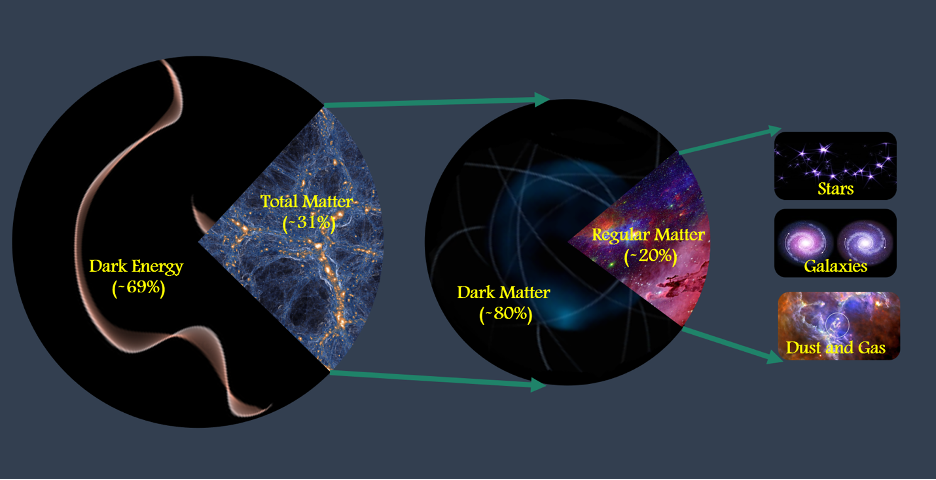
The team determined that matter makes up about 31% of the total amount of matter and energy in the Universe. Cosmologists think that 20% of the total matter is made of ordinary (or "baryonic") matter, which includes stars, galaxies, atoms and life, while about 80% is made of dark matter, whose mysterious nature is not yet known but which may consist of a subatomic particle not yet discovered.
"To put this amount of matter in context, if all the matter in the Universe were spread evenly through space, that would correspond to an average mass density equal to only about six hydrogen atoms per cubic metre," said lead author Mohamed Abdullah, a student in the Department of Physics and Astronomy at UC Riverside. "However, since we know that 80% of matter is actually dark matter, in reality most of this matter consists not of hydrogen atoms but rather of a type of matter that cosmologists do not yet understand."
 |
|---|
| Credits: NASA, ESA, S. Beckwith (STScI) and the HUDF Team |
Abdullah explained that a proven technique for determining the total amount of matter in the Universe is to compare the number and the observed mass of galaxy clusters per unit volume with predictions from numerical simulations. Given that present-day galaxy clusters formed from matter that collapsed over billions of years under their own gravity, the number of clusters observed today is very sensitive to the cosmological conditions and, in particular, to the total amount of matter.
"A higher percentage of matter would result in more clusters," said Abdullah. "The challenge for our team was to measure the number of clusters and then determine which of the answers was the best. But it is difficult to measure the mass of any galaxy cluster accurately because most of the matter is dark, so we cannot see it with telescopes."
To overcome this difficulty, a team of astronomers developed "GalWeight", a cosmological tool to measure the mass of a galaxy cluster using the orbits of its members. The researchers then applied their tool to the SDSS (Sloan/Digital/Sky/Survey) observations to create "GalWCat19", a publicly available catalogue of galaxy clusters. Finally, they compared the number of clusters with simulations to determine the total amount of matter in the Universe.
"We were able to make one of the most precise measurements ever obtained using the galaxy cluster technique," said co-author Gillian Wilson, professor of physics and astronomy at the University of California, Riverside, in whose laboratory Abdullah works. "In addition, this is the first use of the galaxy orbit technique that obtained a value in agreement with those obtained by teams that used non-cluster techniques, such as cosmic microwave background anisotropies, baryonic acoustic oscillations, Type Ia supernovae, or gravitational lensing."
"A great advantage of using our GalWeight galaxy orbit technique is that our team was able to determine a mass for each individual cluster instead of relying on more indirect statistical methods," said third co-author Anatoly Klypin, a specialist in numerical simulations and cosmology.
By combining their measurement with those of other teams that used different techniques, the team was able to determine the best combined value, concluding that matter makes up 31.5±1.3% of the total amount of matter and energy in the Universe
Bibliography: