
Blog and announcements
A warp in the Milky Way linked to a galactic collision
CACP
When most of us picture the shape of the Milky Way, the galaxy that contains our own Sun and hundreds of billions of other stars, we think of a central mass surrounded by a…
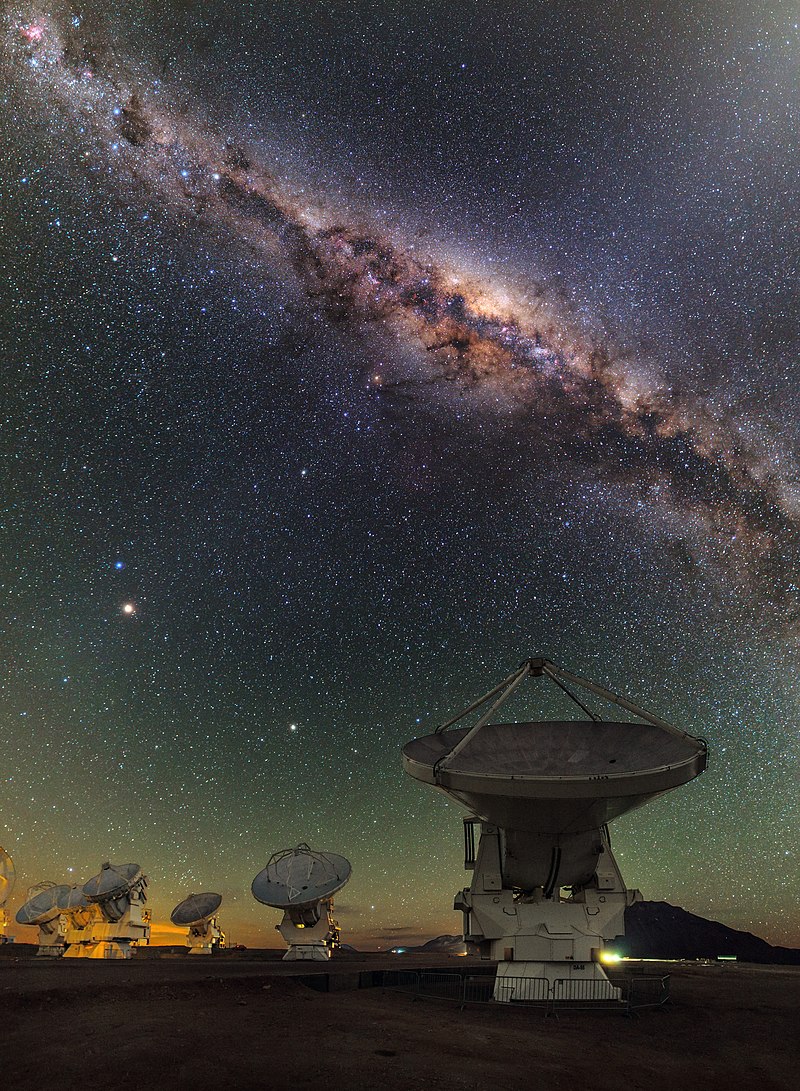
When most of us picture the shape of the Milky Way, the galaxy that contains our own sun and hundreds of billions of other stars, we think of a central mass surrounded by a flat disc of stars spiralling around it. As in the image below:
 |
|---|
| Credit: ESO/B. Tafreshi (twanight.org) |
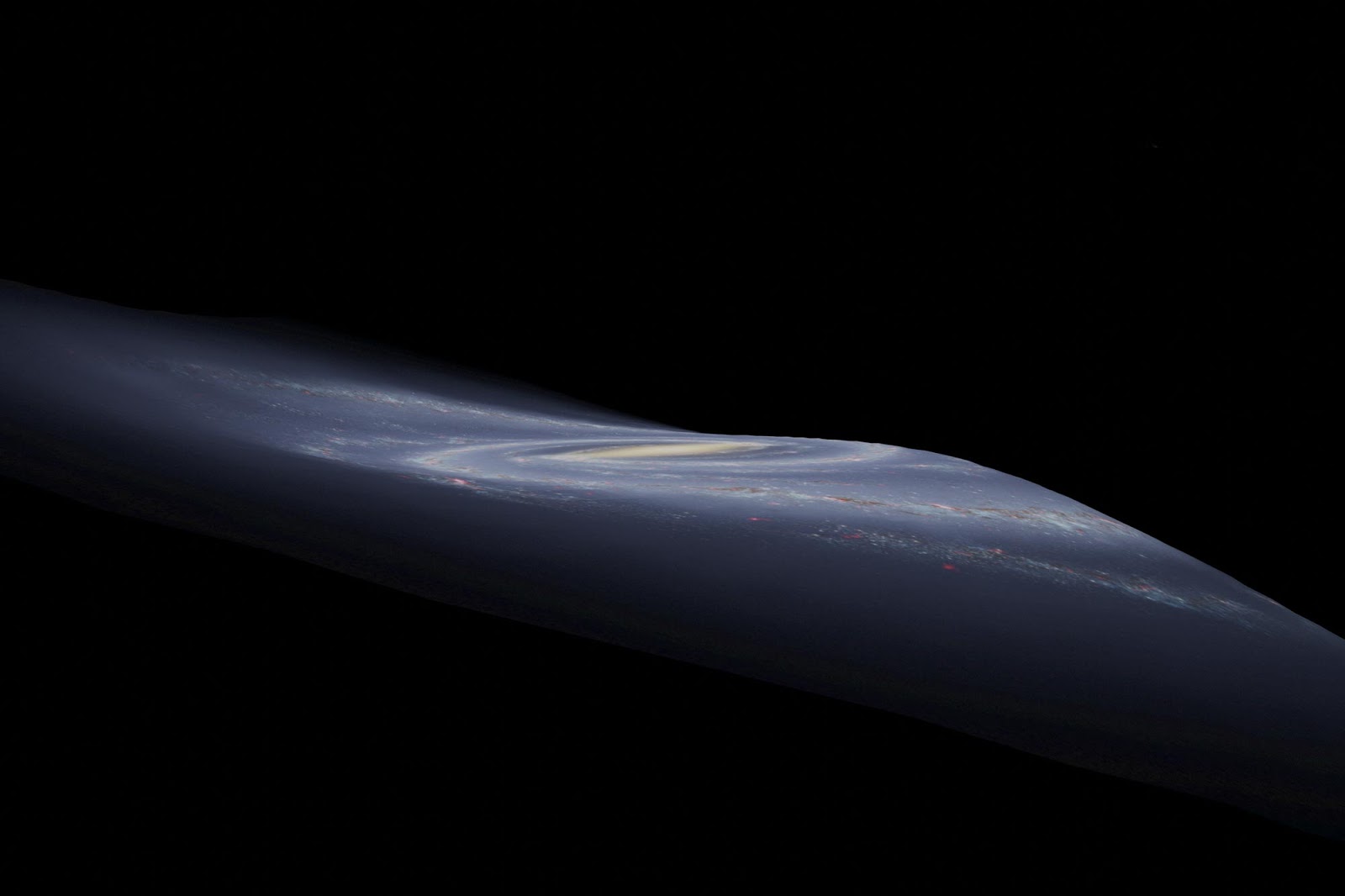
However, astronomers know that, instead of being symmetrical, the structure of the disc is warped, more like the brim of a felt hat, and that the warped edges are constantly in motion around the outer edge of the galaxy.
 |
|---|
| A graphical representation of the Milky Way showing its warped outer edges. (Photo by Xinlun Cheng) |
"If you have seen the audience doing a wave in a stadium, it is very similar to this concept," said Xinlun Cheng, an astronomy student at the College and Graduate School of Arts & Sciences of the University of Virginia. "Each member of the audience stands up and then sits down at the right moment and in the right order to create the wave as it circulates around the stadium. That is exactly what the stars in our galaxy are doing. Only in this case, as the wave is passing through the disc of the galaxy, the disc of the galaxy is also rotating around the centre of the galaxy. In terms of the analogy with sports fans, it is as if the stadium itself were also rotating."
What caused this warp has been the subject of debate. Some researchers suggest that the phenomenon is a result of the instability of the galaxy itself, while others state that it is the remnant of a collision with another galaxy in the distant past.
A recent paper published in The Astrophysical Journal by Cheng, who studies the movements of the stars, and his colleagues, Borja Anguiano, a postdoctoral research associate at UVA, and Steven Majewski, a professor in the Department of Astronomy of the college, may finally put this debate to rest.
Using data from the Gaia space observatory, a satellite launched in 2013 by the European Space Agency to measure the positions, distances and movements of billions of stars, and information from APOGEE, an infrared spectrograph developed by UVA to examine the chemical composition and the movements of the stars, astronomers now have the tools to observe the movements of the stars in the Milky Way with a degree of precision without precedent.
"By combining the information from the APOGEE instrument with the information from the Gaia satellite, we are beginning to understand how the different components of the galaxy are moving," said Anguiano, interested both in the movements of these components and in the phenomena that may have originally caused these movements.
 |
|---|
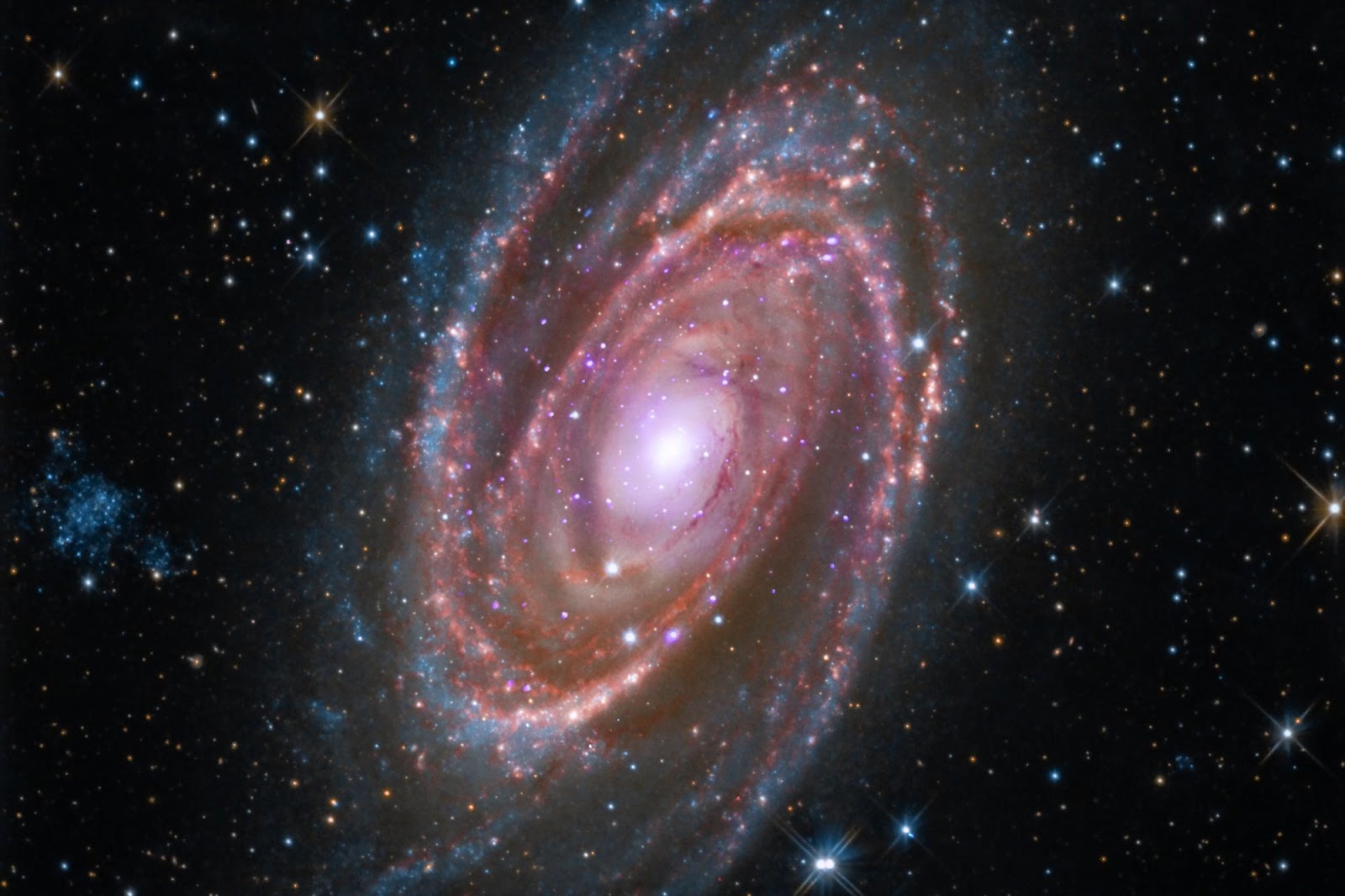
| The spiral galaxy M81, which is similar in size and shape to our own galaxy, the Milky Way. (Photo: NASA) |
"It is now possible to characterise these movements with an unprecedented precision due to the precision and statistical robustness of the enormous catalogue of stars that was surveyed by the Gaia satellite," explained Majewski. "Meanwhile, our large database of stellar chemistries generated by APOGEE gives us the unique ability to infer stellar ages. This allows us to explore how stars of different ages take part in the warp and allows us to see when it was created. Knowing this, then, gives us an idea of why it was created."
Using these data, Cheng and his colleagues developed a model that characterises the parameters of the galactic warp, where it begins in the outer disc, the speed with which the warp moves and the shape of the warp. The model helped them to determine that the deformation, which does not affect our own sun but is passing through our solar system now at speeds that allow it to make a complete rotation around the galaxy every 450 million years, is not a result of the internal mass of the Milky Way itself. Instead, it is the relic of the gravitational pull on the disc of the Milky Way by the close passage of a satellite galaxy, possibly the Sagittarius Dwarf Spheroidal Galaxy, about 3 billion years ago.
"We can still see the disc of our galaxy trembling as a result," said Anguiano.
The data that the team collected with the new tools available to astronomers may be only the beginning of a new wave of discoveries about our universe and how it came about.
"We are entering an era in astronomy, especially in galactic astronomy, in which we measure the movement of stars with a level of precision such that we can map their past orbital paths and begin to understand how they may have been affected in earlier epochs and how other galaxies approaching ours interacted with stars as they were being born," said Anguiano. "This level of precision has opened a new door to understanding the past of our galaxy and how it was assembled."
Bibliography: