
Blog and announcements
Collisions and the origin of the Solar System
The formation of the Sun, the Solar System and the subsequent emergence of life on Earth may be a consequence of a collision between our galaxy, the Milky Way, and a smaller galaxy called Sagittarius, discovered in the 1990s, which orbits our galactic home.
 |
|---|
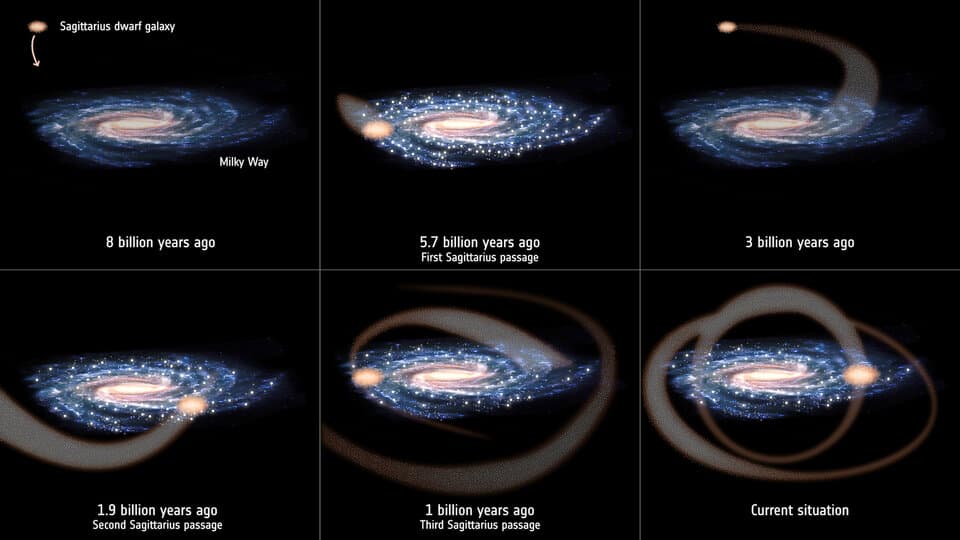
| The Sagittarius dwarf galaxy has been orbiting the Milky Way for billions of years. As its path around the spiral structure of the Milky Way (which is 10,000 times more massive) gradually became smaller due to collisions with the disc of our Galaxy, the three known collisions between Sagittarius and the Milky Way may, according to a new study, have triggered episodes of intense star formation, one of which may have given rise to the Solar System. |
Credit: ESA |
The formation of the Sun, the Solar System and the subsequent emergence of life on Earth may be a consequence of a collision between our Galaxy, the Milky Way, and a smaller galaxy called Sagittarius, discovered in the 1990s, which orbits our galactic home!
Sagittarius collides repeatedly with the disc of the Milky Way, while its orbit around the nucleus of the galaxy tightens as a result of gravitational forces. Previous studies have suggested that the dwarf galaxy had a profound effect on the stars that move in the Milky Way. Scientists state that the spiral structure (trademark of our Milky Way), which is 10 thousand times more massive, may be the result of at least three known accidents with Sagittarius in the last six billion years.
"When we analysed the Gaia data on the Milky Way, we found three periods of greater star formation that peaked 5.7 billion years ago, 1.9 billion years ago and 1 billion years ago, corresponding to the period when Sagittarius is believed to have passed through the disc of the Milky Way," says Tomás Ruiz-Lara, a researcher in Astrophysics at the Instituto de Astrofísica de Canarias (IAC) in Tenerife, Spain, and main author of the new study published in Nature Astronomy.
Ripples in the water
The researchers analysed luminosities, distances and colours of the stars in a sphere of about 6500 light-years around the Sun and compared the data with existing stellar evolution models. According to Tomás, the notion that the dwarf galaxy may have had this effect makes a lot of sense.
"In the beginning you have a galaxy, the Milky Way, which is relatively quiet," says Tomás. "After an initial violent epoch of star formation, partly triggered by an earlier merger, the Milky Way reached a balanced state in which stars formed constantly. Suddenly, you make Sagittarius fall in and disturb the balance, causing all the gas and dust previously stopped inside the larger galaxy to spread out like ripples in water."
In some areas of the Milky Way, these ripples would lead to higher concentrations of dust and gas, while emptying others. The high density of material in these areas would trigger the formation of new stars.
The birth of the Sun
"The Sun formed at the time when stars were forming in the Milky Way because of the first passage of Sagittarius," says Carme. "We do not know whether the specific cloud of gas and dust that turned into the Sun collapsed because of the effects of Sagittarius or not. But it is a possible scenario, because the age of the Sun is consistent with a star formed as a result of the Sagittarius effect."
Every collision takes from Sagittarius part of its gas and dust, leaving the smaller galaxy after each passage. The existing data suggest that Sagittarius may have passed through the disc of the Milky Way again recently, in the last hundred million years, and it is currently very close to it. In fact, the new study found a recent burst of star formation, suggesting a possible new and continuous wave of star birth.
According to ESA's Gaia project scientist Timo Prusti, such detailed information about the star formation history of the Milky Way would not have been possible before Gaia, the star-mapping telescope launched at the end of 2013, whose two data releases in 2016 and 2018 revolutionised the study of the Milky Way.
Bibliography: