
Blog and announcements
First interstellar comet confirmed!
CACP
Hubble observes the 1st confirmed interstellar comet! Text: Fernando Freire. Review: Giulia Tessari. NASA's Hubble Space Telescope has given astronomers the best view of a visitor…
Hubble observes the 1st confirmed interstellar comet!
Text: Fernando Freire Review: Giulia Tessari
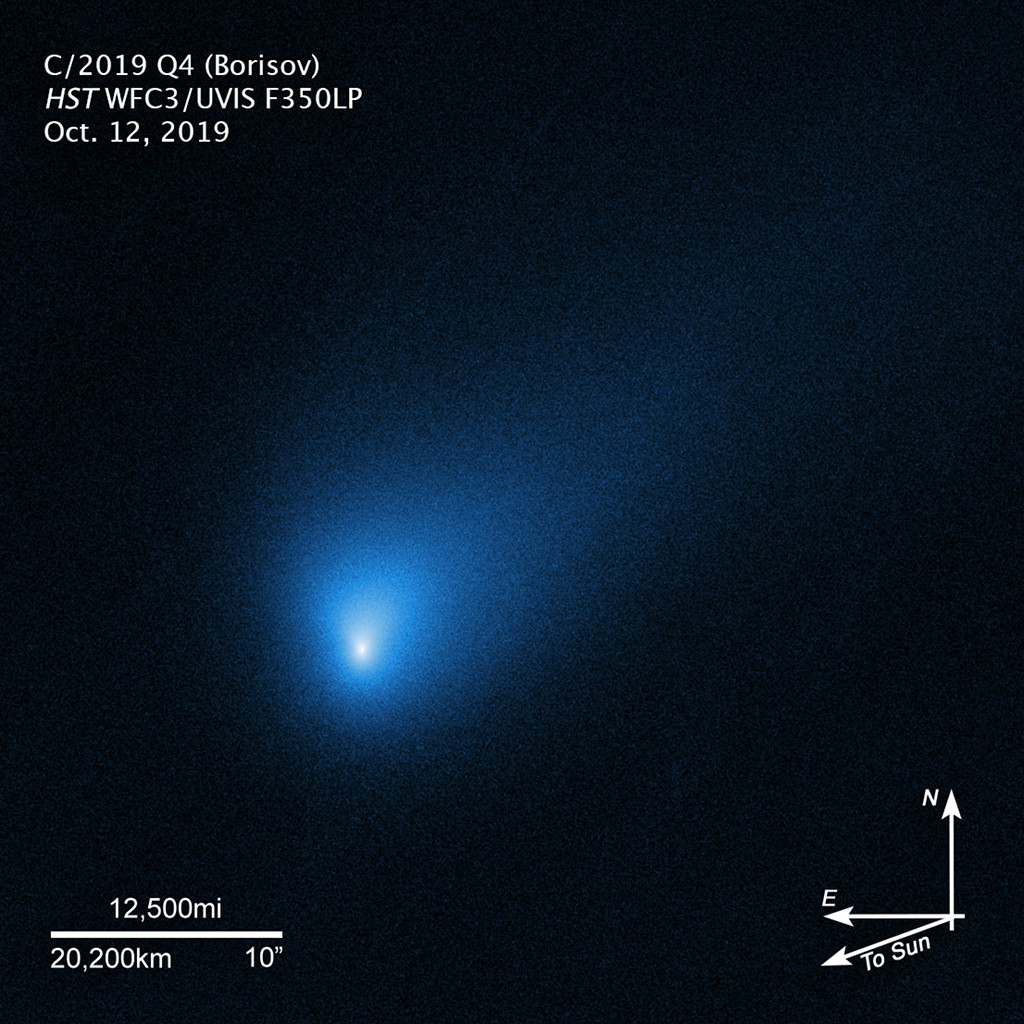
NASA's Hubble Space Telescope has given astronomers the best view of an interstellar visitor - comet 2I/Borisov - whose speed and trajectory indicate that it came from beyond our solar system!
This Hubble image, taken on 12 October 2019, is the sharpest view of the comet to date. Hubble reveals a central concentration of dust around the nucleus (which is far too small to be seen by the space telescope).
Comet 2I/Borisov is only the second interstellar object known to have passed through the solar system. In 2017, the first interstellar visitor identified, an object officially called 'Oumuamua, travelled to within 40 million kilometres of the Sun before leaving the solar system. "While 'Oumuamua looked like a rock, Borisov is really active, more like a normal comet. It is a puzzle because these two are so different," said David Jewitt, of the University of California, Los Angeles (UCLA), leader of the Hubble team that observed the comet.
As the second interstellar object found entering our solar system, the comet provides valuable clues about the chemical composition, structure and dust characteristics of the planetary building blocks, presumably forged in an alien star system long ago and very far away.
"Although another star system may be very different from ours, the fact that the comet's properties look very similar to those of the solar system's building blocks is very remarkable," said Amaya Moro-Martin, of the Space Telescope Science Institute in Baltimore.
Hubble and other telescope observations have shown that rings and shells of icy debris surround young stars where planet formation is under way. A gravitational "pinball game" among these bodies or comet-like planets orbiting other stars may throw them deep into space, where they drift among the stars.
Future Hubble observations of 2I / Borisov are planned until January 2020, with further proposals.
"New comets are always unpredictable," said Max Mutchler, another member of the observation team. "They sometimes brighten suddenly or even begin to fragment when they are exposed to the intense heat of the Sun for the first time. Hubble is ready to monitor whatever happens next with its superior sensitivity and resolution."
Sources:
-
ANDREOLI, Claire; VILLARD, Ray; JEWITT, Stuart Wolpert And David. **Hubble Observes 1st Confirmed Interstellar Comet. **2019. Available at: https://www.nasa.gov/feature/goddard/2019/hubble-observes-1st-confirmed-interstellar-comet. Accessed: 23 Nov. 2019.
-
USA. NASA. . **Interstellar Interloper 2I/Borisov. **2019. Available at: https://apod.nasa.gov/apod/ap191018.html. Accessed: 23 Nov. 2019.