
Blog and announcements
How do young, disordered galaxies grow and mature?
CACP
First of all, the formation of a galaxy most often has black holes at its centres that can produce an enormous amount of energy, which we can see at great distances…
First of all, the formation of a galaxy most often has black holes at its centres that can produce an enormous amount of energy, which we can see at great distances. In some cases, the central black hole of a galaxy is supermassive and active, even in relatively small galaxies. The material that circles the black hole can be accelerated outwards by its jets and thus provide matter for the generation of celestial bodies. Other galaxies may contain quasars (the most energetic bodies of the universe) in their nucleus.
Galaxies are classified by their shape. Each type has different characteristics and a different evolutionary history, and they are:
Some, like the Milky Way, have spiral arms around their centre. Known as spiral galaxies, these groups make up the majority of the galaxies that astronomers can see. The gas and dust in a spiral galaxy surround the centre at speeds of hundreds of kilometres per second, creating its pinwheel shape. Some, known as "barred spirals", have a bar-like structure at the centre, formed by dust and gas channelled towards the centre. The dust and gas in spiral galaxies are constantly feeding the formation of new stars.
Elliptical galaxies do not have the spiral arms of their more flamboyant cousins. Their appearance ranges from circular to very elongated. Elliptical galaxies have less dust than their spiral counterparts and therefore the star formation process is practically almost stagnant. And most of their stars are older.
And finally, the remaining 3% of the galaxies of the universe are known as irregular galaxies. They are neither round nor do they have spiral arms, and their shapes lack a specific definition. The gravity of other galaxies has often affected them, stretching them or deforming them. Collisions or close encounters with other galaxies can also deform their shapes.
But how do some of these types of galaxies begin to be formed?
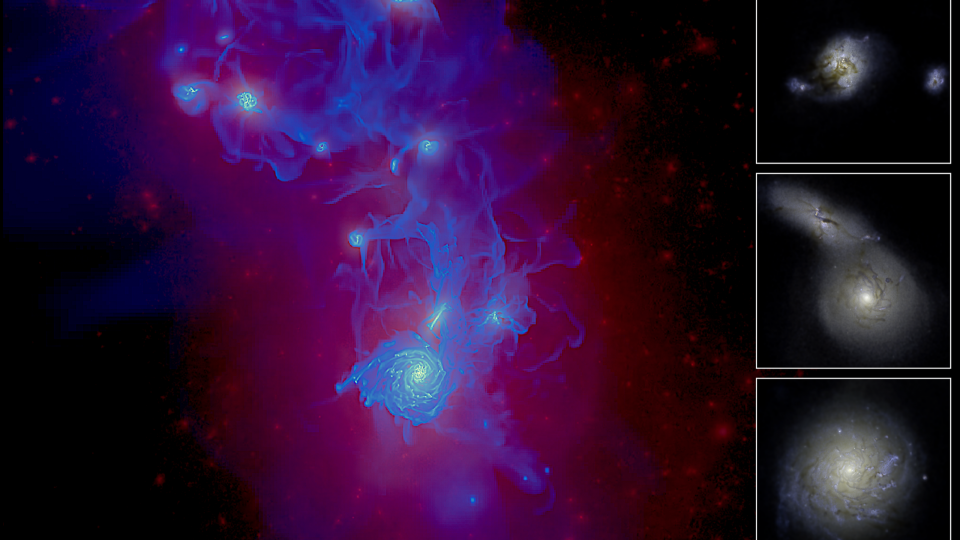 |
|---|
| Supercomputer simulation |
Using a supercomputer simulation, a research team from Lund University, in Sweden, managed to follow the development of a galaxy over 13.8 billion years. The study shows how, due to frontal interstellar collisions, young and chaotic galaxies over time mature into spiral galaxies, like the Milky Way.
Shortly after the Big Bang, 13.8 billion years ago, the Universe was an unruly place. Galaxies collided constantly. Stars formed at an enormous rate inside gigantic clouds of gas. However, after a few billion years of intergalactic chaos, the unruly embryonic galaxies became more stable and over time matured into well-ordered spiral galaxies. The exact course of these developments has long been a mystery to astronomers around the world. However, in a new study published in the Monthly Notices of the Royal Astronomical Society, the researchers managed to shed light on the matter.
"Using a supercomputer, we created a high-resolution simulation that provides a detailed picture of the development of a galaxy since the Big Bang and how young chaotic galaxies make the transition to well-ordered spirals," says Oscar Agertz, astronomy researcher at Lund University.
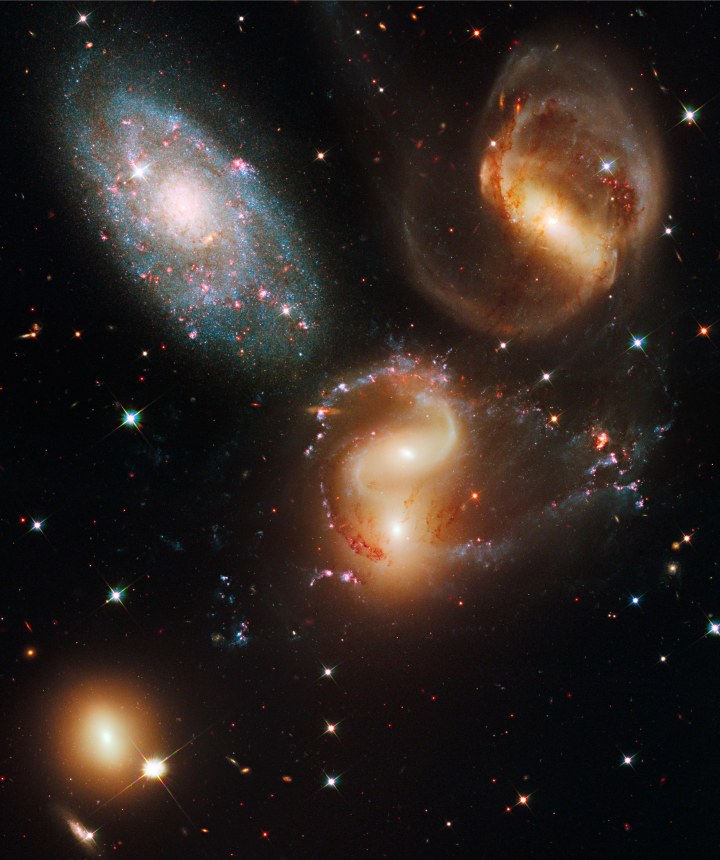
In the study, the astronomers, led by Oscar Agertz and Florent Renaud, use the stars of the Milky Way as a starting point. The stars act as time capsules that reveal secrets about distant epochs and the environment in which they formed. Their positions, velocities and amounts of various chemical elements can therefore, with the aid of computer simulations, help us understand how our own galaxy formed.
"We discovered that when two large galaxies collide, a new disc can be created around the old one due to the enormous flow of star-forming gas. Our simulation shows that the old and new discs slowly merged over a period of several billion years. This is something that not only resulted in a stable spiral galaxy, but also in populations of stars similar to those of the Milky Way," says Florent Renaud, astronomy researcher at Lund University.
The new findings will help astronomers interpret current and future mappings of the Milky Way. The study points to a new direction for research in which the main focus will be the interaction between large galaxy collisions and how the discs of spiral galaxies are formed. The research team in Lund has already started new supercomputer simulations in cooperation with the PRACE research infrastructure (Partnership for Advanced Computing in Europe).
"With the current study and our new computer simulations we will generate a lot of information that will allow us to better understand the fascinating life of the Milky Way since the beginning of the Universe," concludes Oscar Agertz.
Bibliography:
-
Press release: https://www.lunduniversity.lu.se/article/how-disorderly-young-galaxies-grow-and-mature
-
The types of galaxies and their characteristics: https://www.space.com/15680-galaxies.html
-
Blog of weekly articles on astronomy: http://www.ccvalg.pt/astronomia/