
Blog and announcements
Juno spacecraft detections may overturn ideas about the origin of zodiacal light
CACP
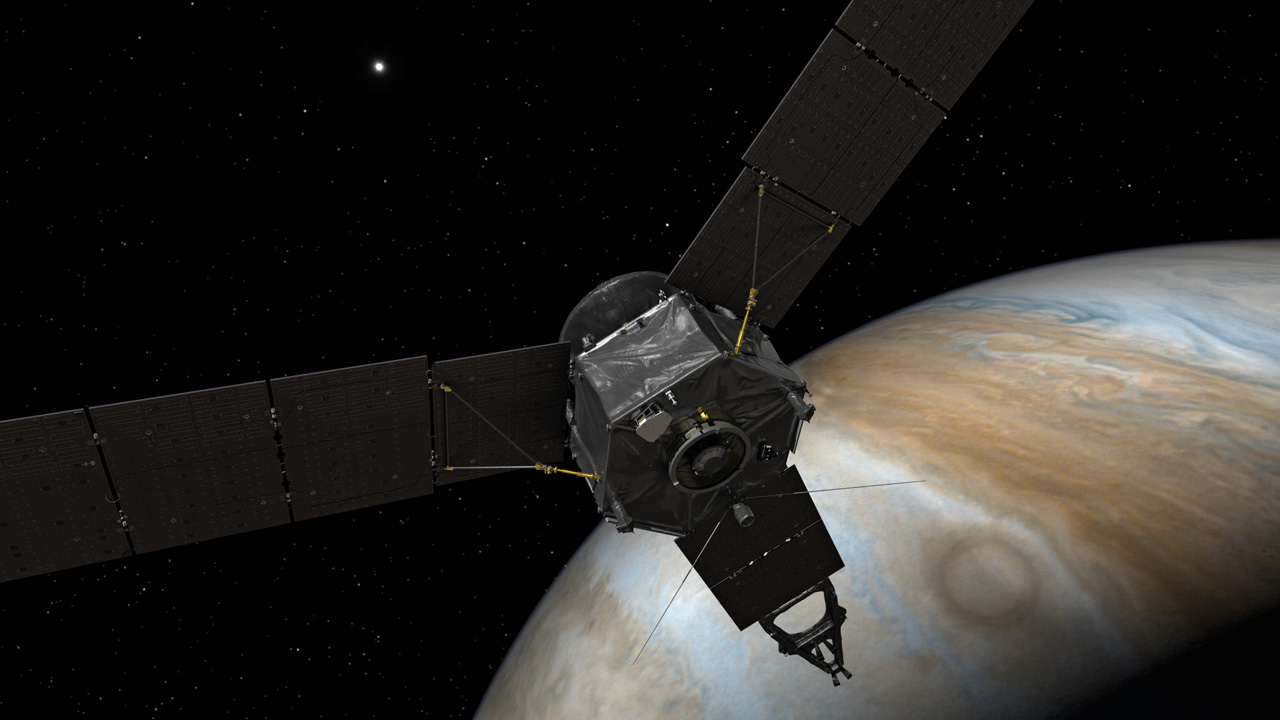
Credit: NASA. Look at the night sky shortly before dawn or after dusk and you may see a faint column of light stretching up from the horizon. That luminous glow is the light…
 |
|---|
| Credit: NASA |
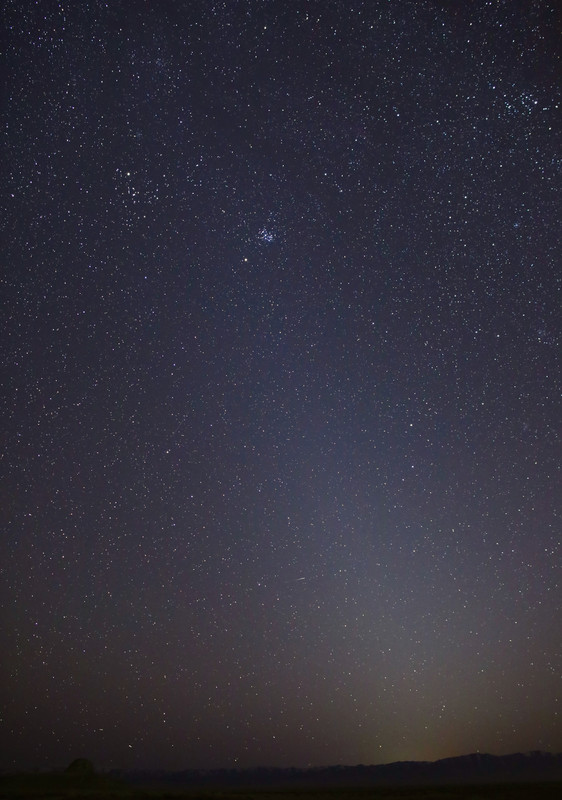
Look at the night sky shortly before dawn or after dusk and you may see a faint column of light stretching up from the horizon. That luminous glow is zodiacal light, or sunlight reflected towards the Earth by a cloud of tiny dust particles orbiting the Sun. Astronomers have long thought that the dust is brought into the inner solar system by some families of asteroids and comets that venture in from afar.
But now a team of Juno scientists argues that Mars may be the culprit. They published their finding online for the first time on 11 November 2020, in the Journal of Geophysical Research: Planets, with a final peer-reviewed paper published on 9 March 2021.
An instrument aboard the Juno spacecraft serendipitously detected dust particles slamming into the spacecraft during its journey from Earth to Jupiter. The impacts provided important clues about the origin and orbital evolution of the dust, resolving some mysterious variations of the zodiacal light.
Although their finding has great implications, the scientists who spent years studying cosmic debris did not plan to do so. "I never thought we would be looking for interplanetary dust," said John Leif Jørgensen, professor at the Technical University of Denmark.
Jørgensen designed the four star trackers that are part of Juno's magnetometer investigation. These cameras aboard take pictures of the sky every quarter of a second to determine Juno's orientation in space, recognising star patterns in their images - an essential engineering task for the precision of the magnetometer.
But Jørgensen hoped that his cameras could also spot an unknown asteroid. So he programmed a camera to report things that appeared in several consecutive images but were not in the catalogue of known celestial objects.
He did not expect to see much: almost all objects in the sky are accounted for in the star catalogue. So when the camera began to transmit thousands of images of unidentifiable objects - streaks appearing and then mysteriously disappearing - Jørgensen and his colleagues were puzzled. "We were looking at the images and saying, 'What could that be?'", he said.
Jørgensen and his team considered many plausible causes and some implausible ones. There was the unnerving possibility that the star camera had captured a fuel tank leaking on Juno. "We thought: 'Something is really wrong'," said Jørgensen. "The images looked like someone was shaking a dusty tablecloth out of the window."
It was not until the researchers calculated the apparent size and speed of the objects in the images that they finally realised something: grains of dust slammed into Juno at about 10,000 miles (or 16,000 kilometres) per hour, chipping off submillimetre pieces. "Even though we are talking about objects with only a tiny amount of mass, they have a terrible impact," said Jack Connerney, head of investigation of Juno's magnetometer and deputy principal investigator of the mission, who works at NASA's Goddard Space Flight Center in Greenbelt, Maryland.
In the end, the spray of debris was coming from Juno's expansive solar panels - the largest and most sensitive unintended dust detector ever built.
"Every fragment we track records the impact of an interplanetary dust particle, allowing us to compile a distribution of dust along Juno's path," said Connerney. Juno was launched in 2011. After a deep-space manoeuvre in the asteroid belt in 2012, it returned to the inner solar system for a gravity assist from Earth in 2013, which catapulted the spacecraft towards Jupiter.
Connerney and Jørgensen noticed that most of the dust impacts were recorded between Earth and the asteroid belt, with gaps in the distribution related to the influence of Jupiter's gravity. According to the scientists, this was a radical revelation. Until now, scientists were unable to measure the distribution of these dust particles in space. Dedicated dust detectors have limited collection areas and therefore limited sensitivity to a sparse population of dust. They mostly count the most abundant and much smaller dust particles from interstellar space. By comparison, Juno's expansive solar panels have 1,000 times more collection area than most dust detectors.
The Juno scientists determined that the dust cloud ends at Earth because Earth's gravity sucks up all the dust that gets near it. "That is the dust we see as zodiacal light," said Jørgensen.
As for the outer edge, about 2 astronomical units (AU) from the Sun (1 AU is the distance between Earth and the Sun), it ends just beyond Mars. At that point, the scientists report, the influence of Jupiter's gravity acts as a barrier, preventing the dust particles from crossing from the inner solar system into deep space. This same phenomenon, known as orbital resonance, also works in the opposite direction, where it blocks dust originating in deep space from passing into the inner solar system.
The profound influence of the gravitational barrier indicates that the dust particles are in a nearly circular orbit around the Sun, said Jørgensen. "And the only object we know of in a nearly circular orbit around 2 AU is Mars, so the natural thought is that Mars is a source of this dust," he said.
"The dust distribution we measured is more consistent with the variation of the zodiacal light observed," said Connerney. The researchers developed a computer model to predict the light reflected by the dust cloud, dispersed by the gravitational interaction with Jupiter, which spreads the dust into a thicker disc. The scattering depends on only two quantities: the inclination of the dust to the ecliptic and its orbital eccentricity. When the researchers plugged in the orbital elements of Mars, the distribution accurately predicted the tell-tale signature of the variation of the zodiacal light near the ecliptic. "That is, in my opinion, a confirmation that we know exactly how these particles are orbiting in our solar system," said Connerney, "and where they originate".
Although there is good evidence now that Mars, the dustiest planet we know of, is the source of the zodiacal light, Jørgensen and his colleagues still cannot explain how the dust could have escaped the clutches of martian gravity. They hope that other scientists will help them.
In the meantime, the researchers note that finding the true distribution and density of dust particles in the solar system will help engineers design materials for spacecraft that can better withstand dust impacts. Knowing the precise distribution of dust can also guide the design of flight trajectories for future spacecraft in order to avoid the greatest concentration of particles. Tiny particles travelling at such high speeds can chip off up to 1,000 times their mass from a spacecraft.
Juno's solar panels escaped damage because the solar cells are well protected against impacts on the back - or dark side - of the panel by the support structure.
Bibliography: