
Blog and announcements
New study suggests supermassive black holes may form from dark matter
CACP
A new theoretical study has proposed a new mechanism for the creation of supermassive black holes from dark matter. The international team found that instead of the scenarios…
A new theoretical study has proposed a new mechanism for the creation of supermassive black holes from dark matter. The international team found that instead of the conventional formation scenarios involving 'normal' matter, supermassive black holes could form directly from dark matter in high-density regions at the centres of galaxies. The result has important implications for cosmology in the early Universe and was published in Monthly Notices of the Royal Astronomical Society.
 |
|---|
| Credit: ESO |
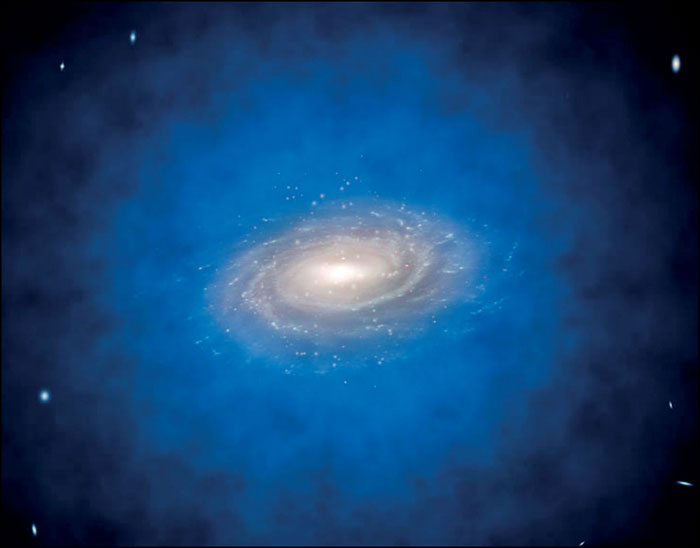
In the image above we have an artistic impression of a spiral galaxy embedded in a larger distribution of invisible dark matter, known as a dark matter halo (coloured in blue). Studies observing the formation of dark matter halos have suggested that each halo could host a very dense core of dark matter, which can mimic the effects of a central black hole, or eventually collapse to form one.
Exactly how supermassive black holes formed initially is one of the biggest problems in the study of galaxy evolution today. Supermassive black holes have been observed 800 million years after the Big Bang, and how they could grow so quickly remains unexplained.
Standard formation models involve normal baryonic matter - the atoms and elements that make up stars, planets and all visible objects - collapsing under gravity to form black holes, which then grow over time. However, the new work investigates the potential existence of stable galactic cores made of dark matter and surrounded by a diluted dark matter halo, finding that the centres of these structures can become so concentrated that they can also collapse into supermassive black holes, once a critical threshold is reached.
 |
|---|
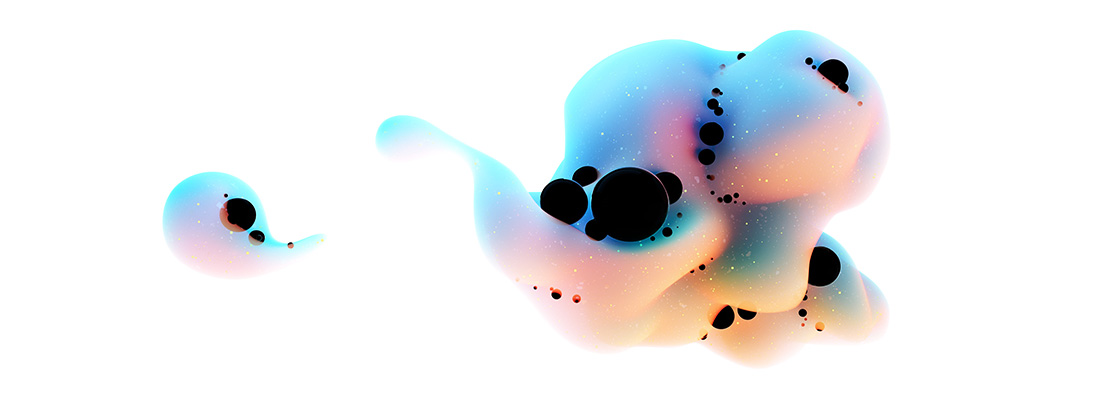
According to the model, this could have happened much faster than other proposed formation mechanisms, and would have allowed supermassive black holes in the early Universe to form before the galaxies they inhabit, contrary to the current understanding.
Carlos R. Argüelles, the researcher from the Universidad Nacional de La Plata and ICRANet who led the investigation, comments: "This new formation scenario may offer a natural explanation for how supermassive black holes formed in the early Universe, without the need for prior star formation or for invoking seed black holes with unrealistic accretion rates".
Another intriguing consequence of the new model is that the critical mass for collapse into a black hole may not be reached for smaller dark matter halos, for example those that surround some dwarf galaxies. The authors suggest that this may leave smaller dwarf galaxies with a central dark matter core instead of the expected black hole. This dark matter core could still mimic the gravitational signatures of a conventional central black hole, while the outer dark matter halo could also explain the observed galaxy rotation curves.
 |
|---|
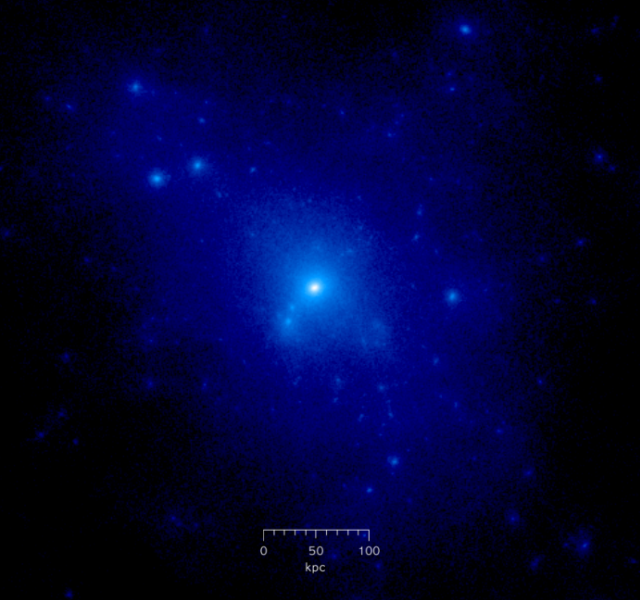
| Dark matter halo simulated from a cosmological simulation of N-body. |
"This model shows how dark matter halos can host dense concentrations at their centres, which may play a crucial role in helping to understand the formation of supermassive black holes," added Carlos.
"Here, we prove for the first time that these core-halo dark matter distributions can indeed form in a cosmological structure and remain stable throughout the life of the Universe."
 |
|---|
The authors hope that further studies will clarify the formation of supermassive black holes in the early days of our Universe, as well as investigate whether the centres of inactive galaxies, including our own Milky Way, can host these dense dark matter cores.
Bibliography: