
Blog and announcements
The 2020 Nobel Prize in Physics
CACP
Reinhard Genzel. Roger Penrose. The theory that led to the discovery. Andrea Ghez. Black holes are, without a shadow of a doubt, home to one of the greatest mysteries of the Universe, being…
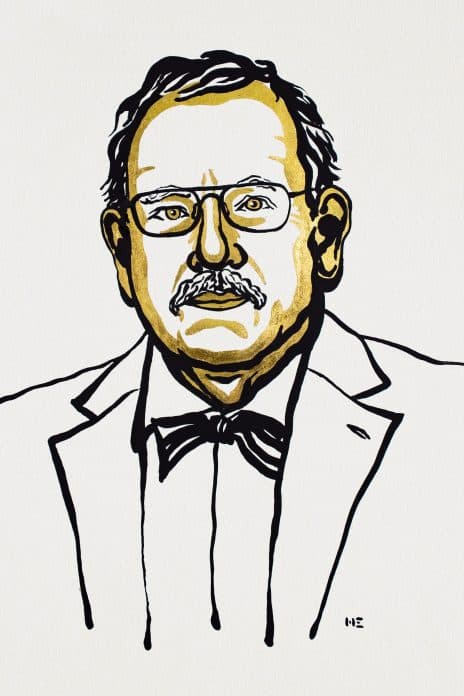
Reinhard Genzel
 |
|---|
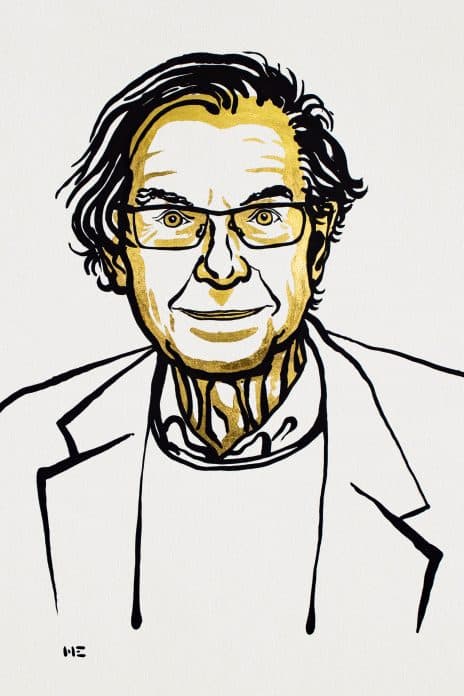
| ### Roger Penrose |
The theory that led to the discovery
 |
|---|
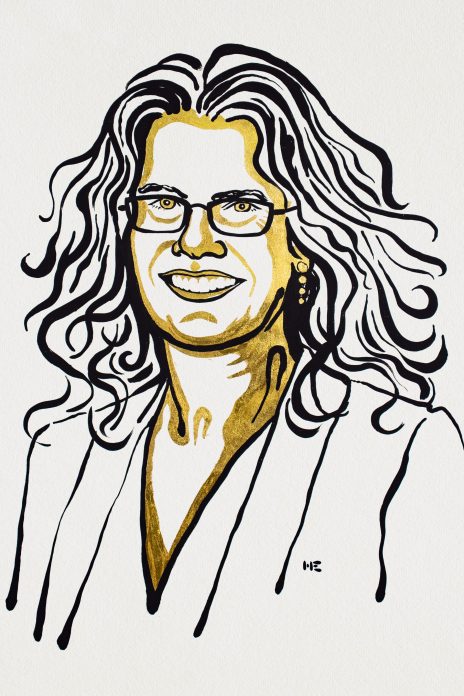
| ### Andrea Ghez |
Black holes undoubtedly hold within themselves one of the greatest mysteries of the universe, having been theorised by John Michell in a letter published in November 1784. Michell's simplistic calculations assumed that this body could have the same density as the Sun and concluded that this body would form when the diameter of a star exceeded that of the Sun by a factor of 500 and the escape velocity from the surface exceeded the usual speed of light. Michell correctly observed that these supermassive but non-radiating bodies could be detected by their gravitational effects on nearby visible bodies. He still used the term "dark star", which in turn is a more correct term than "black hole".
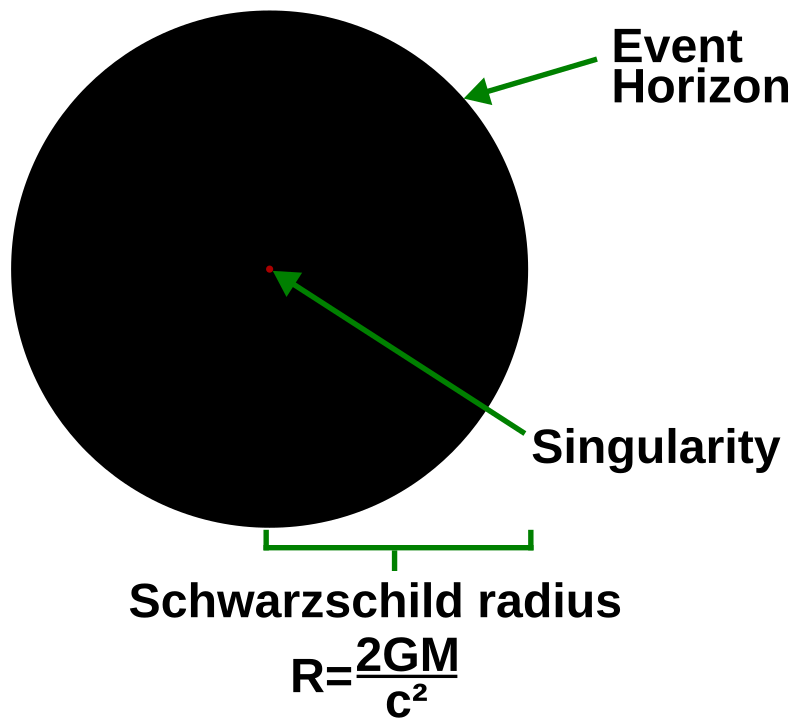
But it was in 1915 that Einstein's general relativity, having previously demonstrated that gravity influences the movement of light. Just a few months later, Karl Schwarzschild found a solution to Einstein's field equations, which describe the gravitational field of a point mass and of a spherical mass. This solution had a peculiar behaviour at what is now called the Schwarzschild radius, where it became singular, meaning that some of the terms in Einstein's equations became infinite. The nature of this surface was not yet fully understood. However, by naming a structure where its core has all its mass at a single point, a singularity of non-physical coordinates was established.
 |
|---|
| credit: wikipedia |
Many other discoveries were made in the following years, but it was in the 1960s that Roger Penrose ignored the detailed geometric structure of space-time and instead focused his attention only on the topology of space, or at most on its conformal structure, since it is the latter - as determined by the configuration of the light cones - that determines the trajectories of light-like geodesics and therefore their causal relations. The importance of Penrose's epoch-making paper, "Gravitational collapse and space-time singularities", was not its only result, summarised roughly as that if an object such as a dying star implodes beyond a certain point, nothing can prevent the gravitational field from becoming so strong as to form some kind of singularity.
It was in the local context of gravitational collapse that Penrose's contribution was most decisive, starting with his 1969 cosmic censorship conjecture, in the sense that any subsequent singularities would be confined within a well-behaved event horizon around a hidden space - a region of time for which Wheeler coined the term black hole - leaving a visible outer region with strong but finite curvature, from which part of the gravitational energy can be extracted by what is known as the Penrose process, while the accumulation of surrounding matter can release more energy that can explain astrophysical phenomena such as quasars.
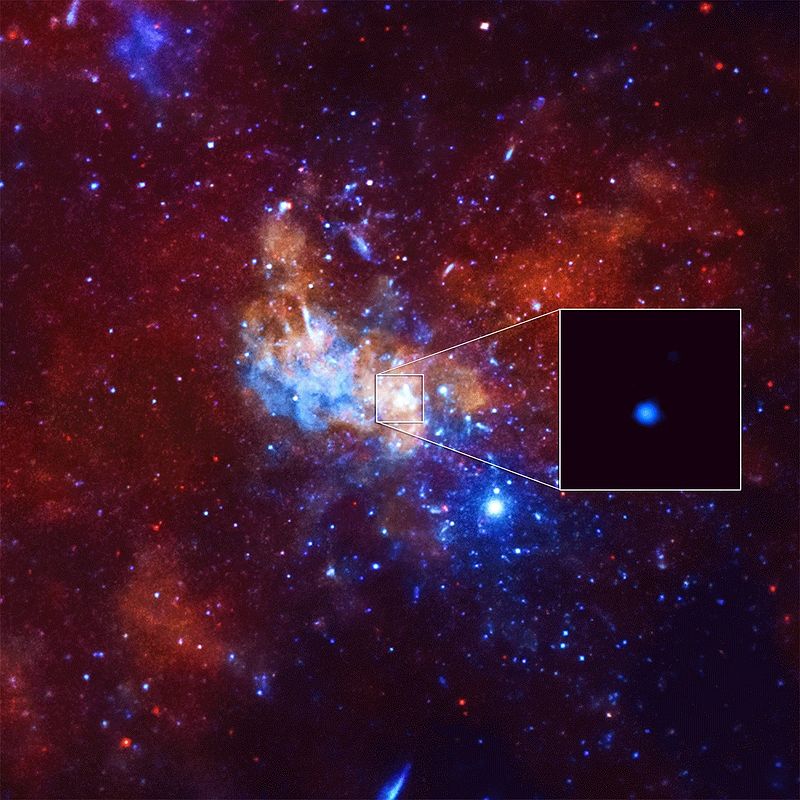
Reinhard Genzel and Andrea Ghez each lead a group of astronomers who, since the early 1990s, have focused on a region called Sagittarius A* at the centre of our galaxy. The orbits of the brightest stars near the middle of the Milky Way have been mapped with increasing precision. The measurements of these two groups agree, with both finding an extremely heavy invisible object that pulls the cluster of stars, making them run at dizzying speeds. About four million solar masses are gathered in a region no larger than our solar system.
 |
|---|
| Detection of an exceptionally bright X-ray flare from Sgr A |
| credit: NASA |
Using the largest telescopes in the world, Genzel and Ghez over a period of ten years - according to the team's analysis, the data rule out the possibility that Sagittarius A* contains a set of dark stellar objects or a mass of degenerate fermions, reinforcing the evidence for a supermassive black hole. The team developed a method to see through the enormous clouds of interstellar gas and dust to the centre of the Milky Way. Pushing the limits of technology, they refined new techniques to compensate for the distortions caused by the Earth's atmosphere, building unique instruments and committing themselves to long-term research. Their pioneering work has given us the most convincing evidence of a supermassive black hole at the centre of the Milky Way.
VLBI radio observations of Sagittarius A* could also be aligned centrally with the images so that S2 could be seen orbiting Sagittarius A*. By examining the Keplerian orbit of S2, they determined that the mass of Sagittarius A* was 2.6 ± 0.2 million solar masses, confined in a volume with a radius no greater than 17 light-hours (120 AU). Later observations of the star S14 showed that the mass of the object was about 4.1 million solar masses within a volume with a radius no greater than 6.25 light-hours (45 AU) or about 6.7 billion kilometres.
After monitoring stellar orbits around Sagittarius A* for 16 years, Gillessen estimated the mass of the object at 4.31 ± 0.38 million solar masses. The result was announced in 2008 and published in The Astrophysical Journal in 2009. Reinhard Genzel, head of the research, said the study presented "what is now considered the best empirical evidence that supermassive black holes really exist."
 |
|---|
| Credit: EHT |
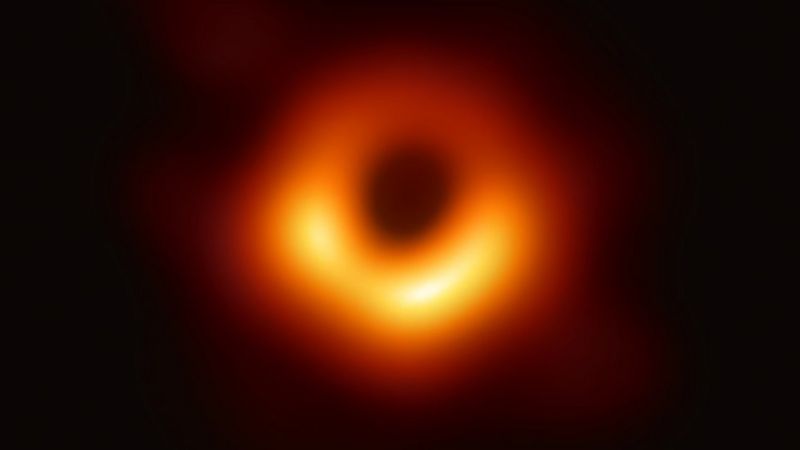
And in 2019, we have this...
Bibliography: