
Blog and announcements
The brightness of the black hole's ring
CACP
Astronomers from the Event Horizon Telescope conclude from archival data how the surroundings of the mass monster in galaxy M 87 have changed. Geometric and EHT array modelling of…
Astronomers from the Event Horizon Telescope conclude from archival data how the surroundings of the mass monster in galaxy M 87 have changed
 |
|---|
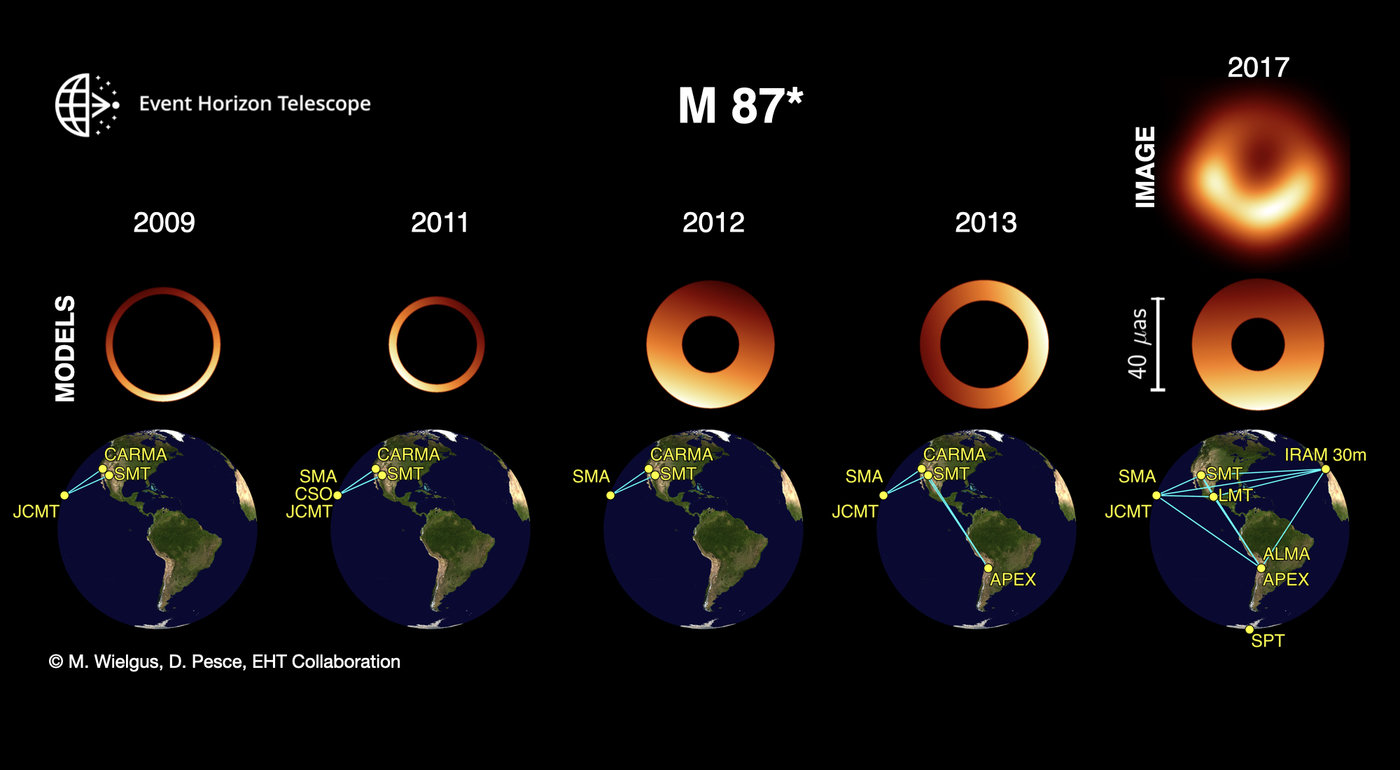
| Geometric modelling of the EHT telescope array in 2009-2017. The diameter of all the rings is similar, but the location of the bright side varies. The variation in the thickness of the ring is probably not real and results from the limited number of observatories taking part in earlier experiments. |
© M. Wielgus, D. Pesce & EHT Collaboration |
The image of this mass monster published last year and obtained with the Event Horizon Telescope (EHT) went around the world. Now the EHT team has analysed archival data from 2009 to 2013, some of which were not yet published. The researchers found that the ring-shaped shadow around the black hole is always present, but changes its orientation and distribution of brightness (the ring appears to be shining). The participation of the European APEX telescope in Chile and of the 30-metre IRAM telescope co-financed by the Max Planck Society at Pico Veleta in the Spanish Sierra Nevada played an important role in this discovery.
 |
|---|
| Animation representing one year of evolution of M87* according to numerical simulations. The measured angular position of the bright side of the crescent is shown, together with a ring of 42 microarcseconds. For part of the animation, the image obtained by the EHT is shown. |
Credit: G. Wong, B. Prather, Ch. Gammie, M. Wielgus & EHT Collaboration |
The observations from 2009-2013 consist of far less data than those carried out in 2017, making it difficult to picture M 87 without assumptions. For the available archival data, the EHT team used statistical modelling based on geometric assumptions to observe the changes in the appearance of the black hole in M 87 over time.
Expanding the analysis to the observations from 2009-2017, the scientists showed that M 87 meets the theoretical expectations. The diameter of the black hole's shadow remained consistent with the prediction of Einstein's theory of general relativity for a black hole of 6.5 billion solar masses. The morphology of an asymmetric ring persists on timescales of several years, in a consistent way that provides additional confidence about the nature of M 87 and the origin of its shadow.
| |  |
| --- |
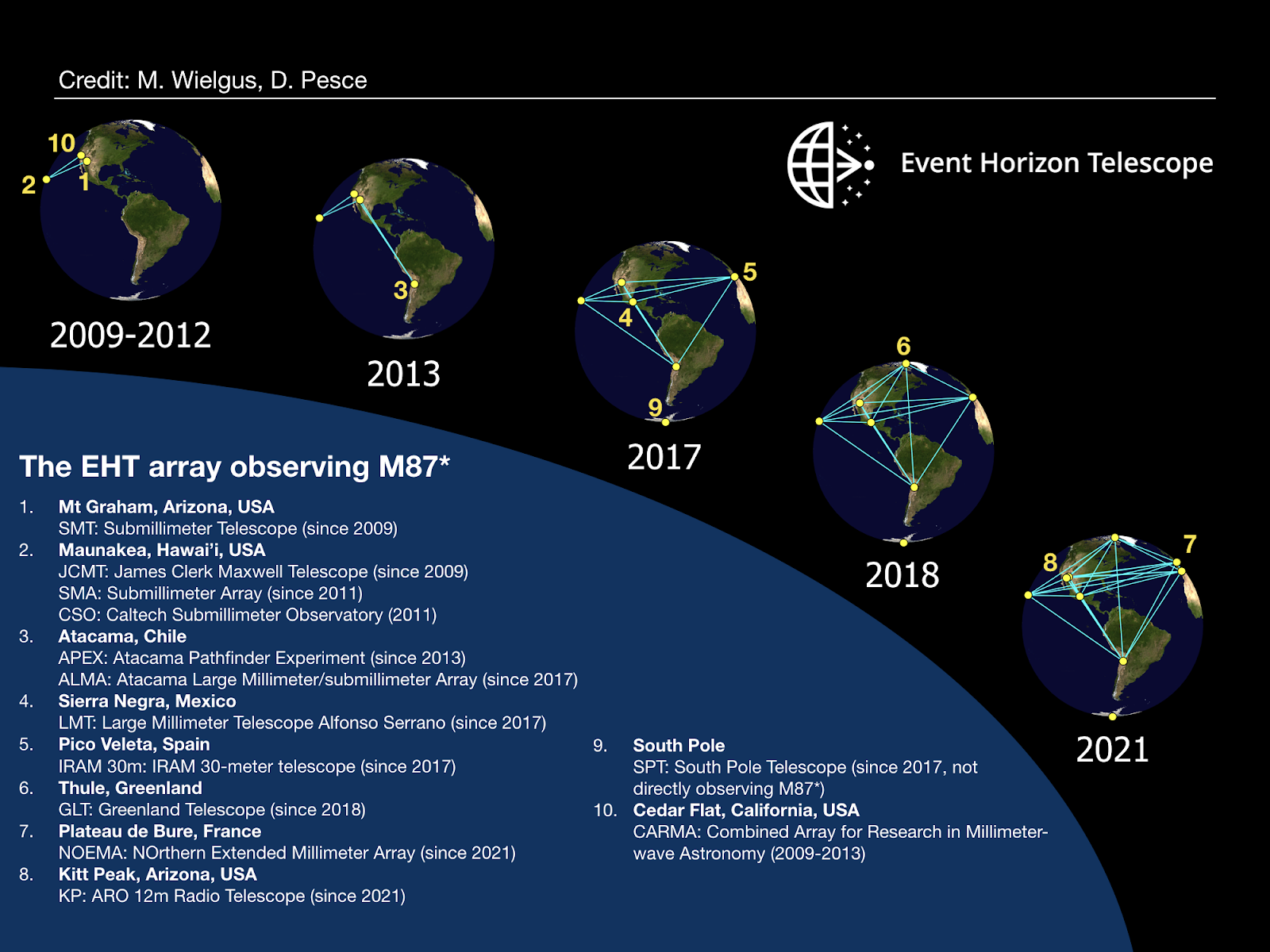
| Telescopes participating in the EHT observations of M87*. Credit: M. Wielgus, D. Pesce & the EHT Collaboration | |
| --- |
| |
| Telescopes participating in the EHT observations of M87*. Credit: M. Wielgus, D. Pesce & the EHT Collaboration |
But although the diameter of the ring remained constant over time, the EHT team found that the data hid a surprise. Thomas Krichbaum, astronomer at the Max Planck Institute for Radio Astronomy and one of the main authors of the publication, states: "The analysis of the data suggests that the orientation and the fine structure of the ring vary with time. This gives a first impression of the dynamic structure of the accretion flow, which surrounds the event horizon". He adds: "Studying this region will be crucial for a better understanding of how black holes accrete matter and launch relativistic jets".
The gas that falls into a black hole heats up to billions of degrees, ionises and becomes turbulent in the presence of magnetic fields. Because the flow of matter is turbulent, the brightness of the ring appears to flicker over time, which challenges some theoretical models of accretion.
"Monitoring the time-variable structure of M87 with the EHT is a challenge that will keep us busy in the coming years," states Anton Zensus, Director of the Max Planck Institute for Radio Astronomy and Founding Chairman of the EHT Collaboration Board. "We are working on the analysis of the 2018 data and preparing new observations in 2021, with the addition of new sites, such as the NOEMA Observatory in France, the most powerful radio telescope of its kind in the Northern Hemisphere and also co-financed by the Max-Planck-Gesellschaft, as well as the Greenland Telescope and Kitt Peak in Arizona," adds Zensus. The improved imaging capabilities provided by this extended array will provide a more detailed view of the shadow of the black hole M 87* and of the innermost jet of the radio galaxy M 87.
An animation showing the consistency of the measured ring diameter and the uncertainties of the orientation measurement. Credit: M. Wielgus & the EHT Collaboration
EHT project scientist Geoffrey Bower, research scientist at the Academia Sinica Institute of Astronomy and Astrophysics (ASIAA), added: "Monitoring M87* with an expanded EHT array will provide new images and much richer data sets to study the turbulent dynamics. We are already working on the analysis of the data from the 2018 observations, obtained with an additional telescope located in Greenland. In 2021, we are planning observations with two more sites, providing extraordinary image quality. This is a truly exciting moment to study black holes!"
Bibliography: