
Blog and announcements
The Milky Way's family tree decoded
CACP
Scientists have known for some time that galaxies can grow thanks to the merging of smaller galaxies, but the ancestry of our own Galaxy, the Milky Way, has long…
Scientists have known for some time that galaxies can grow thanks to the merging of smaller galaxies, but the ancestry of our own Galaxy, the Milky Way, has long been a mystery. Now an international team of astrophysicists has managed to reconstruct the first complete family tree of our Galaxy, analysing the properties of the globular clusters that orbit the Milky Way with artificial intelligence. The work was published in the journal Monthly Notices of the Royal Astronomical Society.
Globular clusters are dense groups with up to a million stars that are almost as old as the Universe itself. The Milky Way hosts more than 150 of these clusters, many of which formed in the smaller galaxies that merged to form the Galaxy we live in today. Astronomers have suspected for decades that the "old age" of globular clusters would mean that they could be used as "fossils" to reconstruct the early histories of the "assembly" of galaxies. However, only with the most recent models and observations has it become possible to fulfil this promise.
 |
|---|
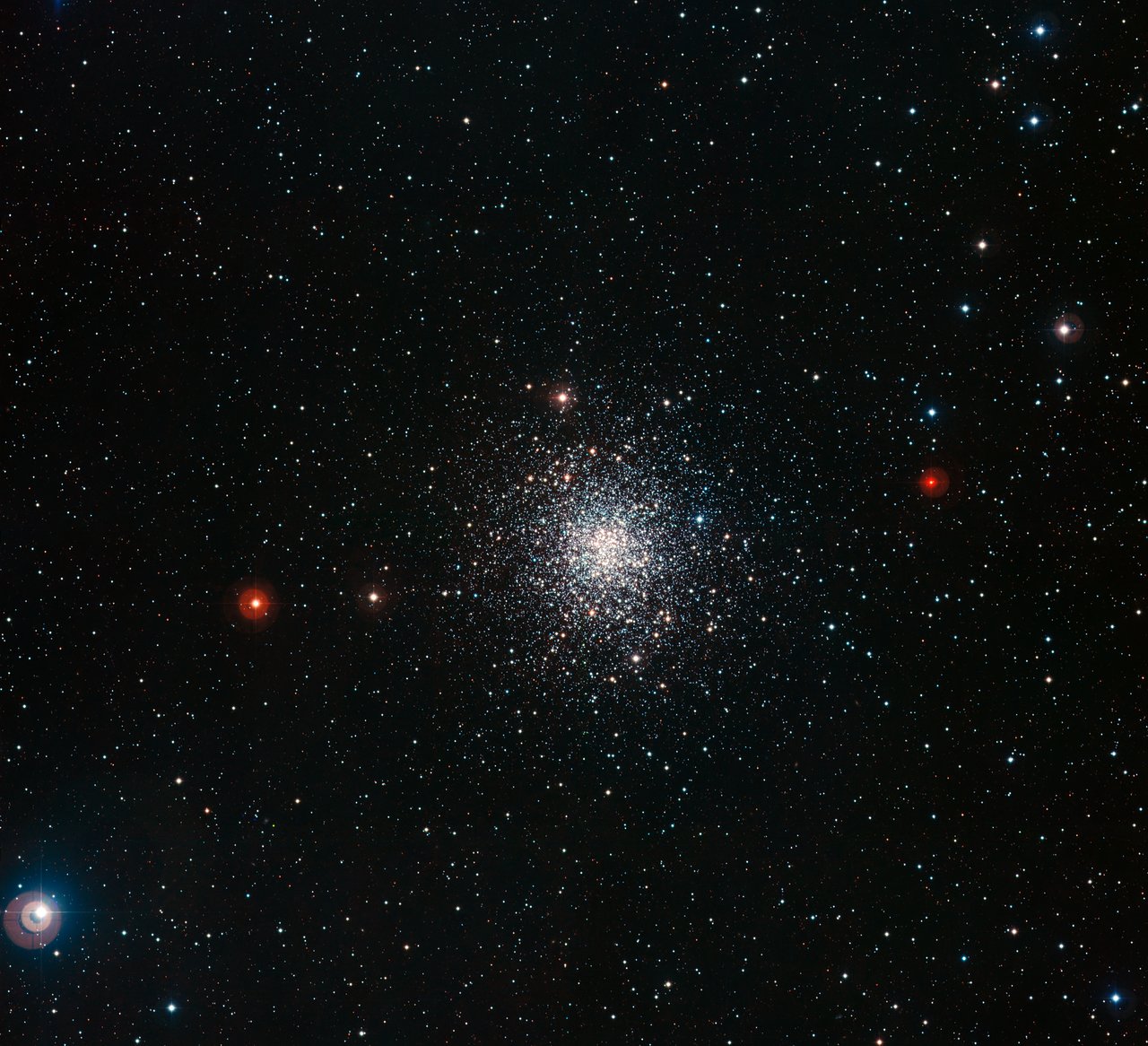
| Globular cluster Messier 107 |
| Credit: ESO |
An international team of researchers led by Dr Diederik Kruijssen of the Centre for Astronomy of the University of Heidelberg and by Dr Joel Pfeffer of John Moores University in Liverpool has now managed to infer the merger history of the Milky Way and reconstruct its family tree, using only its globular clusters.
To achieve this, they developed some advanced computer simulations of the formation of galaxies similar to the Milky Way. Their simulations, called E-MOSAICS, are unique because they include a complete model for the formation, evolution and destruction of globular clusters.
In the simulations, the scientists managed to relate the ages, chemical compositions and orbital motions of the globular clusters to the properties of the progenitor galaxies in which they formed, more than 10 billion years ago. By applying this information to groups of globular clusters in the Milky Way, they were able not only to determine how many stars these progenitor galaxies contained, but also when they merged with the Milky Way.
"The main challenge of linking the properties of globular clusters to the merger history of their parent galaxy has always been that galactic 'assembly' is an extremely messy process, during which the orbits of the globular clusters are completely reorganised," explains Kruijssen.
"To understand the complex system that remains today, we decided, therefore, to use artificial intelligence. We trained an artificial neural network on the E-MOSAICS simulations to relate the properties of globular clusters to the merger history of the host galaxy. We tested the algorithm tens of thousands of times on the simulations and were surprised by the precision with which it was able to reconstruct the merger histories of the simulated galaxies, using only their populations of globular clusters."
Inspired by this success, the researchers set out to decipher the merger history of the Milky Way. To do so, they used groups of globular clusters that are thought to have been formed in the same progenitor galaxy based on their orbital motion. By applying the neural network to these groups of globular clusters, the scientists were able not only to predict the stellar masses and merger times of the progenitor galaxies with high precision, but also to reveal a previously unknown collision between the Milky Way and an enigmatic galaxy, which the researchers named "Kraken".
 |
|---|
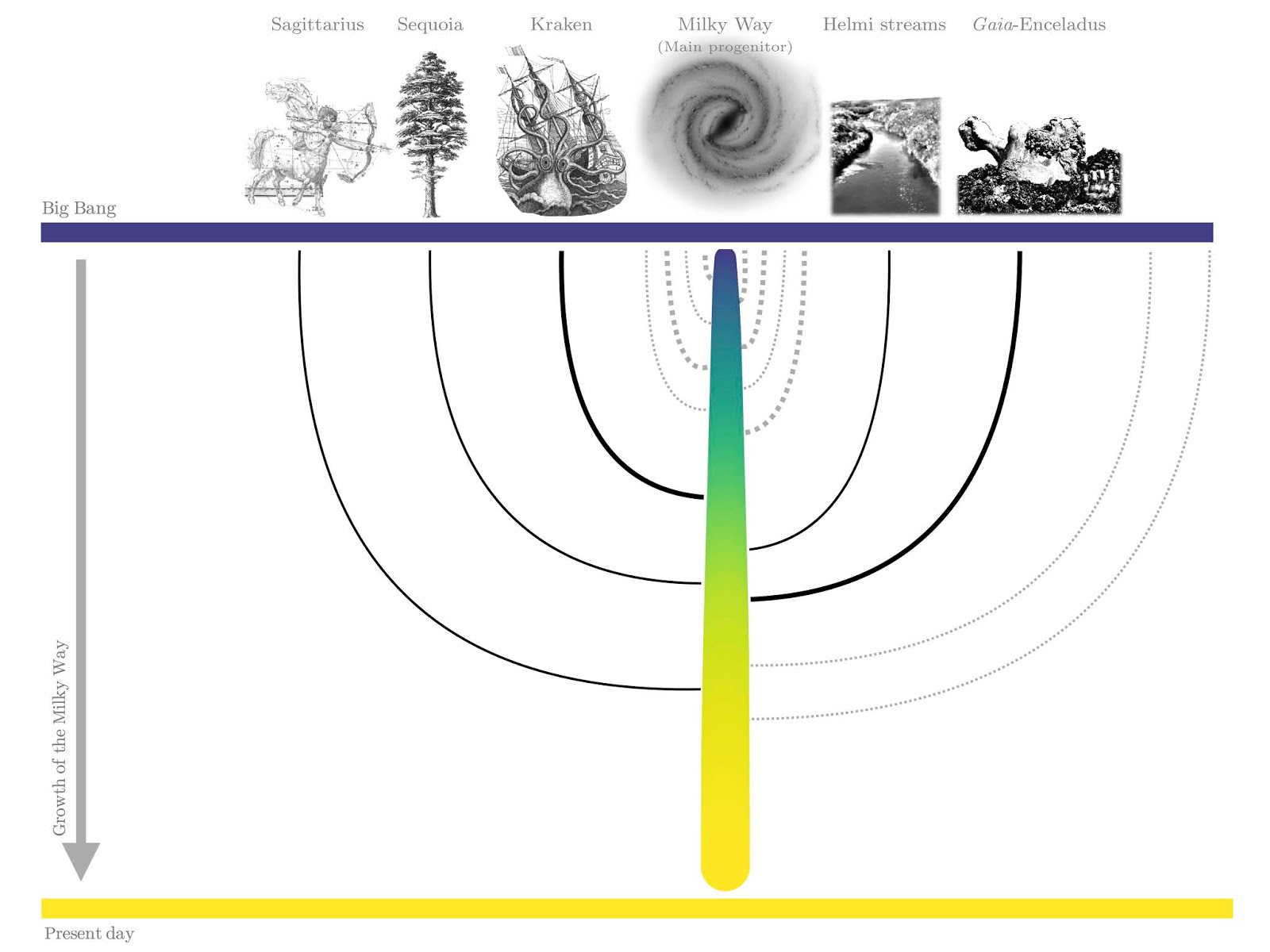
| From left to right, the six images in the upper part of the figure indicate the identified progenitor galaxies: Sagittarius, Sequoia, Kraken, the main progenitor of the Milky Way, the progenitor of the Helmi Streams and the galaxy Gaia-Enceladus-Sausage. |
"The collision with Kraken must have been the most significant merger that the Milky Way has ever suffered," adds Kruijssen. "Previously, it was thought that a collision with the galaxy Gaia-Enceladus-Sausage, which occurred about 9 billion years ago, was the biggest collision event.
However, the merger with Kraken took place 11 billion years ago, when the Milky Way was four times less massive. As a result, the collision with Kraken must really have transformed the appearance of the Milky Way at the time."
Together, these discoveries allowed the team of researchers to reconstruct the first complete merger tree of our Galaxy. Throughout its history, the Milky Way has cannibalised about five galaxies with more than 100 million stars and about fifteen with at least 10 million stars. The most massive progenitor galaxies collided with the Milky Way 6 to 11 billion years ago.
The scientists hope that their predictions will stimulate future studies to search for the remnants of these progenitor galaxies. "The debris of more than five progenitor galaxies has now been identified. With current and future telescopes, it should be possible to find them all," concludes Kruijssen.
Bibliography: