
Blog and announcements
The rise of space debris
CACP
The Rise of Space Debris. Text: Fernando Freire. Review: Giulia Tessari. Space Debris. Orbital debris, or 'space junk', is any man-made object in orbit around…
The Rise of Space Debris
Text: Fernando Freire
Review: Giulia Tessari
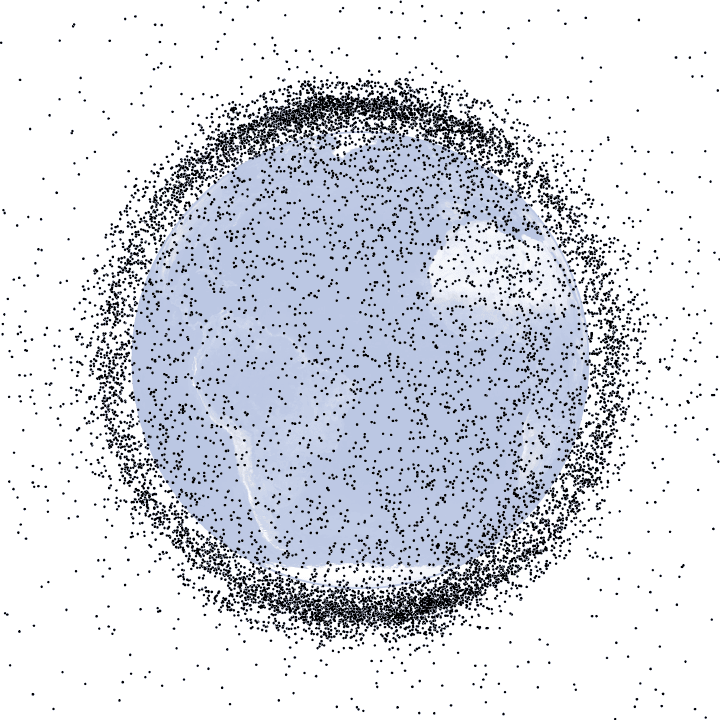
Space Debris
Orbital debris, or "space debris", is any object created by man in orbit around the Earth that no longer serves a useful purpose.
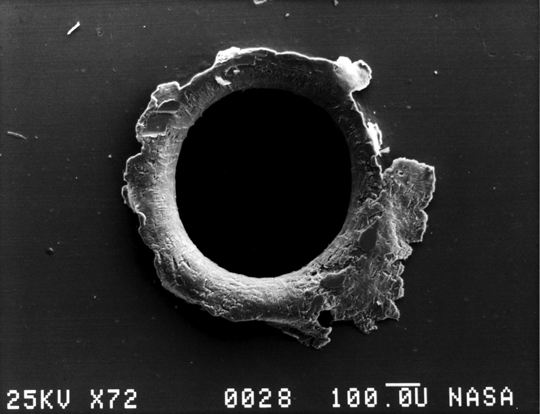
Risks
Hole of approximately 500 microns (the size of the full stop at the end of this sentence.) caused by a piece of debris on the Orion Satellite.
Since the beginning of the space age, low Earth orbit has been increasingly taken over by debris from launch remains, deliberate and even accidental destruction of satellites and objects lost by astronauts, as well as rocket parts. The junk is increasing at a rate that has ended up becoming a threat to spacecraft and astronauts.
The US National Research Council assessed that the debris are so numerous that collisions between them in orbit will produce additional debris more quickly than the waste that re-enters the atmosphere.
At this moment, millions of objects of sizes from 5 mm surround the Earth in a cloud moving at high speed, each one with enough energy to affect a satellite.
However, some companies focusing on the space surveillance part, together with the US Air Force, are planning to adopt measures to manage the threat of this junk. The Space Fence will be a new 6 billion dollar radar system. The contracts were issued for development and construction in 2014, with the start of operation foreseen for the fourth quarter of 2019. However, Lockheed Martin expects to enter operation in 2021.
The location and the higher wave frequency of the new Space Fence radars will allow the detection of microsatellites and debris much smaller than those detected by current systems. In addition, Lockheed Martin's Space Fence project will significantly improve the timeliness with which operators can detect space events that may represent potential threats to GPS satellites or to the International Space Station. The flexibility and sensitivity of the system will provide coverage of deep-space geosynchronous orbits, maintaining the surveillance fence.
Space Fence and other smaller-scale projects aim to increase what the military calls "space situational awareness". But how this knowledge can culminate in corrective action - the removal of space debris - is still rather vague.
The initial Space Fence installation will be located at Kwajalein Atoll, in the Marshall Islands, together with an option for another radar site in Western Australia.
Technical Characteristics:
Space Fence will use S-band radar and will track a greater number of small objects than previous space radars: "about 200,000 objects and make 1.5 million observations per day, about 10 times the number" made by existing or recently retired American assets.
Source:
-
https://www.lockheedmartin.com/en-us/products/space-fence.html
-
Scientific American year 10 no. 115