
Blog and announcements
Transit of Mercury
CACP
Transit of Mercury. Text by: Fernando Freire. Review: Giulia Tessari. On 11/11 we took the telescope out to observe the Sun and followed, with proper protection, the whole passage…
Transit of Mercury
Text by: Fernando Freire Review: Giulia Tessari
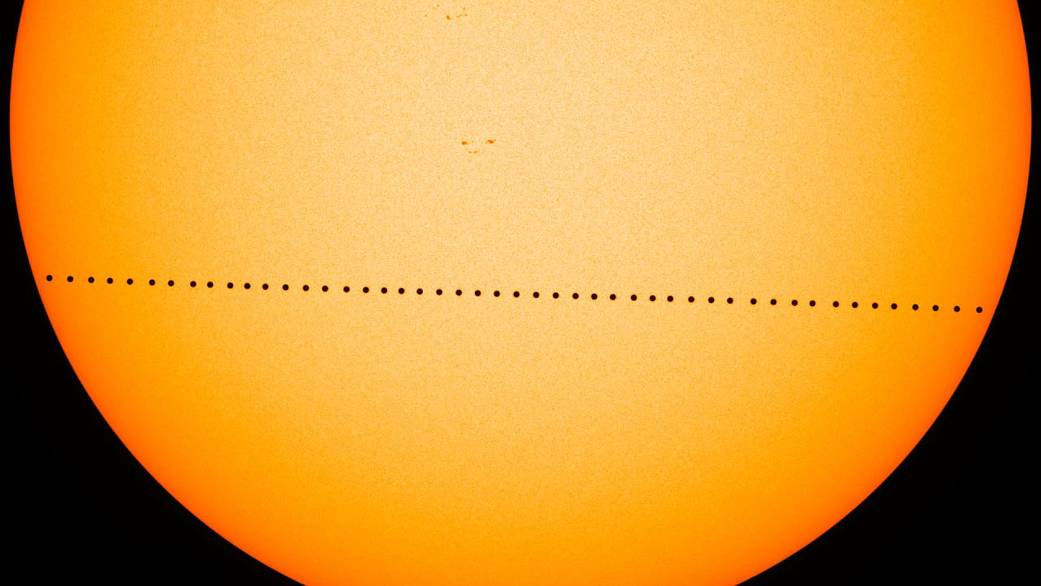
On 11/11 we took the telescope out to observe the Sun and followed, with the proper protection, the whole passage of the small planet Mercury. It is impossible to see any difference with the naked eye and, even with the telescope, we see a small round silhouette crossing the solar disc.
It began at 9:35 and ended at 15:04. Even though it is a long event, it was already possible to see a great difference in the position of the planet between two observations spaced only 10 minutes apart!
The transit always happens at intervals of 3, 7 and 13 years. The last one was 3 years ago and the next one will happen in 13 years, in 2032.
The discovery
 Pierre Gassendi (1592-1655) was a French philosopher and astronomer. And it was in Paris, in the year 1631, that he observed for the first time, with the telescope he used to look at sunspots, the planet Mercury carrying out a solar transit.
Gassendi projected the image of the Sun onto a paper screen in a dark room. He adjusted the projection he had obtained to a circle that he divided into 60 equal parts of 30º (arcseconds).
Gassendi published his results in 1647, receiving support from Galileo Galilei (1564-1642), who had long thought that Mercury would indeed be smaller than was thought.
For the illustrious Italian astronomer, the angular size of the planets should be considered smaller because, through the telescope, their images appeared without the "adventitious rays" that made them look bigger. Even so, he and other astronomers of his time had great difficulty in measuring the angular size of the planets.
The transit also helped Johannes Kepler (1571-1630) to improve the parameters of the strange orbit of Mercury. But until then, no one had thought of using them to measure the distance from the Earth to the Sun.
It was Edmond Halley (1656-1742), famous for the comet that bears his name, who had this idea, although he was unable to carry it out. In the 18th century, for the first time in history, the transits of Venus counted on a wide international cooperation of scientists.
But Halley's method only reached a satisfactory precision in the following century. And, later, with photographic observation and the application of radar measurements on Venus, the error of this measurement was reduced to a mere 30 metres!
Climbing, step by step, other rungs in scientific knowledge, we were able to apply similar methods to determine the distance of more distant stars. And so the Solar System - and our understanding of the Cosmos - kept growing.
Characteristics
The transits of Mercury with respect to the Earth are much more frequent than the transits of Venus, occurring about 13 or 14 times each century.
The transits of Mercury can happen in May or November, and the November transits are twice as frequent as those of May! Currently, they occur on dates close to 8 May and 10 November, varying by a few days. The interval between one November transit and the next transit in this month can be 3, 7 or 13 years, while the interval between two transits in May can be 13 or 33 years.
The May transits are less frequent than those of November because, during the May transit, Mercury is close to aphelion (the point of greatest distance from the Sun), while in November it is close to perihelion (the point of greatest approach). Transits at perihelion are more frequent due to two factors: first, Mercury moves faster in its orbit at perihelion and can reach the transit node more quickly; and second, at perihelion, Mercury is closer to the Sun, having a smaller parallax.
During the May transits, Mercury has an angular diameter of 12º and they occur at the descending node of Mercury's orbit. During the November transits, Mercury has an angular diameter of 10º and these transits occur at the ascending node.
The transits of Mercury are gradually shifting towards the end of the year; before 1585, they happened in April and October.
IMPORTANT:
DO NOT PLAY WITH THE SUN! ALWAYS USE A SOLAR ASTRONOMICAL FILTER ON YOUR EQUIPMENT!
NEVER LOOK DIRECTLY AT THE SUN WITH THE NAKED EYE! USE SOLAR GLASSES THAT BLOCK UV RADIATION!
IN SOLAR ASTRONOMICAL OBSERVATION, NEVER LEAVE BINOCULARS, TELESCOPES OR SPOTTING SCOPES WITHIN THE REACH OF CHILDREN!
Mercury transit of 11/11
Sources:
-
COSTA, JosÉ Roberto V. et al (Ed.). **O trânsito de Mercúrio e o tamanho do Sistema Solar. **2016. Available at: http://www.zenite.nu/o-transito-de-mercurio-e-o-tamanho-do-sistema-solar/. Accessed: 23 Nov. 2019.
-
**Mercury Transit (Composite Image). **2016. Available at: https://www.nasa.gov/image-feature/goddard/2016/mercury-transit-composite-image. Accessed: 23 Nov. 2019.
-
https://spacetoday.com.br/o-transito-de-mercurio-de-9-de-maio-de-2016/
-
https://pt.wikipedia.org/wiki/Tr%C3%A2nsito_de_Merc%C3%BArio