
Blog and announcements
With the help of an amateur astronomer, Hubble helps us study one more supernova
CACP
Credits: NASA, ESA, J. DePasquale (STScI), M. Kornmesser and M. Zamani (ESA/Hubble), A. Riess (STScI/JHU), the SH0ES team and the Digitized Sky Survey. This gif zooms into the spiral galaxy…
 |
|---|
| Credits: NASA, ESA, J. DePasquale (STScI), M. Kornmesser and M. Zamani (ESA / Hubble), A. Riess (STScI / JHU) and the SH0ES team and the Digitized Sky Survey |
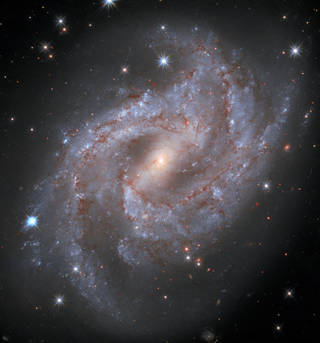
This gif zooms into the barred spiral galaxy NGC 2525, located 70 million light-years away, in the southern constellation of Puppis. About half the diameter of our Milky Way, it was discovered by the British astronomer William Herschel in 1791 as a "spiral nebula". The sharpness of the image increases as we zoom into the Hubble view. As we approach an outer spiral arm, a time-lapse video from Hubble is inserted, showing the faint light of supernova 2018gv. Hubble did not record the initial explosion in January 2018, but for almost a year it took consecutive photos, from 2018 to 2019, which were assembled into a time-lapse sequence. At its peak, the exploding star was as bright as 5 billion suns.
Hubble began observing SN 2018gv in February 2018, after the supernova was first detected by amateur astronomer Koichi Itagaki a few weeks earlier, in mid-January. Hubble astronomers were using the supernova as part of a programme to precisely measure the rate of expansion of the universe - a key value for understanding the physical foundations of the cosmos. The supernova serves as a milestone for measuring the distances of galaxies, a fundamental value needed to measure the expansion of space.
In the time-lapse sequence, which covers almost a year, the supernova first appears as a blazing star located on the outer edge of the galaxy. It initially outshines the brightest stars of the galaxy before disappearing from view.
"No display of Earthly fireworks can compete with this supernova, captured in its fading glory by the Hubble Space Telescope," said the 2011 Nobel Prize winner Adam Riess, of the Space Telescope Science Institute (STScI) and Johns Hopkins University in Baltimore, leader of the High-Z Supernova Search Team and Supernovae H 0 for the Equation of State (SH0ES) Team to measure the rate of expansion of the universe.
 |
|---|
| Credits: NASA, ESA and A. Riess (STScI / JHU) and |
| the SH0ES team; acknowledgement: M. Zamani (ESA / Hubble) |
The type of supernova seen in this sequence originated from a burnt-out star - a white dwarf located in a close binary system - which is accreting material from its companion star. When the white dwarf reaches a critical mass, its core becomes hot enough to start nuclear fusion, turning it into a giant atomic bomb. This thermonuclear runaway process tears the dwarf apart. The opulence lasts little, as the fireball fades quickly.
Because supernovae of this type peak at the same brightness, they are known as "standard candles", which act as cosmic tape measures. Knowing the real brightness of the supernova and observing its brightness in the sky, astronomers can calculate the distances of their host galaxies. This allows astronomers to measure the rate of expansion of the universe. Over the last 30 years, Hubble has helped to drastically improve the precision of the rate of expansion of the universe.
Bibliography: